Disclosure Requirement SBM-1 – Strategy, business model and value chain
VIG is the leading insurance group in Central and Eastern Europe and is well diversified. It consists of the listed VIG Holding and around 50 insurance companies and pension funds in 30 countries in Central and Eastern Europe. Based on the principle of local entrepreneurship, it adopts a decentralised management approach in order to best meet the different requirements of the markets in which it operates. The decentralised organisational structure gives local management and employees of VIG Group the necessary flexibility to conduct their business activities. This allows products and sales to be adjusted optimally to local circumstances. To fulfil its mission, VIG employs around 30,000 people.
VIG serves a total of around 33,300,000 customers, including private individuals, small and medium enterprises (SMEs) and large companies. VIG Holding itself has no retail or SME business. This business is conducted by the local VIG insurance companies. VIG Holding handles the corporate business both itself and through the local VIG insurance companies. VIG attaches great importance to being close to their customers and, to this end, pursue a multi-channel distribution approach. The insurance companies belonging to VIG offer insurance solutions that have been adapted to the local conditions and the needs of customers and policyholders. VIG’s insurance portfolio is diverse and comprehensive, covering a broad spectrum of needs for both individuals and corporates. In addition to property and casualty insurance, there are options such as supplementary health insurance, nursing care insurance, endowment insurance, term life insurance and investment-oriented products that meet specific customer requirements.
The VIG companies are responsible for managing a large volume of capital, which is why security and sustainability are the focus of the investment strategy. Diligence guides the reinsurance policy: To obtain the optimal risk balance, some risks are bundled at the Group level and some are placed on the international reinsurance market. The insurance companies invest the relevant portion of the premiums collected in such a way that they are able to fully meet their obligations to their policyholders at all times. Security is the top priority for investments, which is why good credit ratings and stable returns are preferred. Further information can be found in the consolidated financial statements in the chapter “Risk strategy and risk management” and in the solvency and financial report, which is available on the company’s website. VIG’s responsible investment, insurance and reinsurance practices also reflect a focus on environmental aspects and social responsibility. This includes the exclusion of certain (sub-)sectors/issuers from its investment universe and its underwriting activities (see website). The exclusion criteria are described in chapter ESRS E1-2 “Policies related to climate change mitigation and adaptation”. In addition, VIG monitors and manages key parts of its investment and risk portfolio from an environmental perspective, in particular with regard to CO2 emissions.
A breakdown of total income that deviates from the IFRS consolidated financial statements is not required under the ESRS. The revenue reported in segment reporting in accordance with IFRS 8 includes issued business. This revenue is shown in the income statement under “Insurance service revenue – issued business” and amounted to EUR 13,195,975 in 2025 (2024: EUR 12,138,477)
The disclosures on additional material ESRS sectors required under ESRS 2 SBM-1 § 40(d) refer, in accordance with clarifications by the European Financial Reporting Advisory Group (EFRAG), to direct revenues from sectors of the entity’s own business activities, and not to those of policyholders or investee companies. VIG itself does not generate revenue from activities associated with fossil fuels, chemicals production, controversial weapons, or tobacco cultivation and production. Consequently, this datapoint does not apply to VIG.
Strategic sustainability orientation
Key elements of VIG’s general sustainability efforts are set out in the strategic programme, of which the VIG sustainability programme is an integral part. The previous strategy programme VIG25 was updated for the next three years at the beginning of 2026. The new evolve28 strategy includes the Group strategy, values and Group programmes. Further details are described in the chapters “Group Strategy evolve28” and “Sustainability programme” in the Group Annual Report. Sustainability remains an essential element and is anchored in VIG as one of five Group programmes. The programmes support the implementation of individual business strategies, based on the principle of local entrepreneurship, and build on the trends of the coming years. The social and environmental responsibility of VIG is described in the VIG sustainability programme and defines six spheres of impact that are actively managed within VIG. The three spheres of impact of own internal operations, underwriting and asset management focus primarily on ecological aspects and the three areas of employees, customers and society primarily on social aspects.
With regard to environmental responsibility, a focus is placed on reducing emissions. VIG is committed to the 1.5-degree goal of Paris by 2050. Detailed information on the transition plan, climate targets and the related measures intended to contribute to achieving the emissions reduction targets can be found in the chapters ESRS E1-1 “Transition plan for climate change mitigation”, ESRS E1-2 “Policies related to climate change mitigation and adaptation” and ESRS E1-3 “Actions and resources in relation to climate change policies”. The VIG sustainability programme defines the levers for the three environmental spheres of impact to achieve emission reductions and also to make a sustainable contribution.
In the area of asset management, VIG pursues an engagement approach, is expanding green investments and has also defined exclusion criteria for specific sectors as well as for breaches of human rights and the principles of the UN Global Compact. In underwriting, as in asset management, the engagement approach and defined exclusion criteria apply. In addition, VIG offers products and services to help customers adapt better to climate change. Group-wide carbon accounting forms the basis for emissions reduction in both spheres of impact.
VIG offers policyholders a wide range of insurance products and services tailored to the needs of the different policyholder segments (corporate customers, SMEs and retail customers). The product range includes, among others, motor third party liability and motor own damage insurance, accident insurance, liability insurance, fire and natural hazards insurance as well as travel insurance. Regarding sustainability aspects, local insurance companies have introduced coverage extensions in individual products that encourage the adoption of green technologies and support climate risk mitigation efforts. Such products are only introduced if the risk is insurable, the product is accepted in the market and adequate reinsurance coverage is available, thus meeting the criteria for financial sustainability.
The advantages of structuring products for customers include comprehensive risk coverage and a conservative investment and reinsurance policy. Other stakeholders also benefit from VIG’s commitment to sustainability, employee development and corporate social responsibility. With the promise “Protecting what matters”, VIG wants to contribute to closing existing insurance gaps, increasing the resilience of the population and thus making a contribution to society.
For VIG, resilience also means that consumers in particular are aware of everyday risks and know how to mitigate them. Only those who know their risks can consciously protect themselves against them. VIG therefore focuses both on promoting products such as term life, accident and homeowners’ insurance, and on strengthening risk literacy among the population. Details on this can be found in ESRS S4 “Consumers and end-users”. Details on the key financial performance indicators that form the basis for assessing the business development are described in the Group management report in the chapter “Financial performance indicators”.
VIG also offers comprehensive services for corporate customers as part of the support process. The VIG Group company Risk Consult Sicherheit- & Risiko- Managementberatung GmbH (Risk Consult) carries out natural hazard risk analyses specifically for large companies. It uses mathematical models and local factors to accurately assess potential threats. In some cases, insurance coverage is linked-to on the implementation of these recommended measures, ensuring that policyholders are better protected against natural hazards. Detailed information is provided in ESRS E1-3 “Actions and resources in relation to climate change policies”.
In the motor sector, local insurance companies are closely tied to the development of the vehicle market in the countries. Motor vehicle liability insurance is mandatory in all VIG countries (except Georgia), which is why there is little scope for action for insurance companies; in addition, the coverage of risk liability is socially relevant (resilience). As a major motor insurer in Central and Eastern Europe, VIG aims to take responsibility and, as part of its sustainability programme, implements measures to promote safe and environmentally responsible driving. In Austria, for example, the insurance industry is working to raise awareness among retail customers and SMEs of the impacts of climate change. For this reason, the “Kuratorium für Verkehrssicherheit” is co-financed, among others, by the Austrian insurance industry. Originally founded to raise awareness in the area of traffic and to reduce the number of accidents, the focus in recent years has increasingly expanded to include the impact of climate change on property damage.
In internal operations, the levers for reducing the company’s own greenhouse gas emissions include implementing energy-saving measures, using renewable energy, promoting environmentally friendly business travel, and raising employees’ awareness of sustainability.
Qualified and motivated employees play a central role in the provision of high-quality insurance services for customers. That is why great importance is attached to continuously increasing our attractiveness as an employer and developing our corporate culture. In addition, IT is a key factor for operational performance and is focused on ensuring the highest security standards and implementing regulatory requirements. Within VIG, a comprehensive and effective compliance management system has been established in at least all (re-)insurance companies, asset management companies and pension funds in which VIG Holding holds more than 50% of the shares, directly or indirectly, ensuring compliance with regulatory requirements. Further details can be found in the respective topic chapters.
VIG contributions to the UNGC principles
As part of its sustainability efforts, VIG has been committed to the United Nations Global Compact (UNGC) and its ten principles since 2021 and publishes an annual progress report outlining its contribution to these principles. These principles are taken into account in VIG’s investment decisions, among other things, and form part of the “Responsible Investment” declaration. The table below shows the chapters of the consolidated non-financial report that address VIG’s contributions to the Principles of the UNGC.
Human Rights
Principle 1 – Businesses should support and respect the protection of internationally proclaimed human rights.
| Disclosure Requirement | Paragraphs in the consolidated non-financial report | |
|
ESRS 2 SBM-3 |
Material impacts, risks and opportunities and their interaction with strategy and business model |
|
|
ESRS 2 IRO-2 |
Disclosure requirements in ESRS covered by the undertaking’s consolidated non-financial report |
|
|
ESRS 2 MDR-P |
||
|
ESRS S1.SBM-2 |
||
|
ESRS S1-1 |
||
|
ESRS S1-17 |
||
|
ESRS S4-1 |
Principle 2 – Businesses should make sure that they are not complicit in human rights abuses.
| Disclosure Requirement | Paragraphs in the consolidated non-financial report | |
|
ESRS 2 SBM-3 |
Material impacts, risks and opportunities and their interaction with strategy and business model |
|
|
ESRS 2 IRO-2 |
Disclosure requirements in ESRS covered by the undertaking’s consolidated non-financial report |
|
|
ESRS 2 MDR-P |
||
|
ESRS S1.SBM-2 |
||
|
ESRS S1-1 |
||
|
ESRS S1-17 |
||
|
ESRS S4-1 |
Labour
Principle 3 – Businesses should uphold the freedom of association and the effective recognition of the right to collective bargaining.
| Disclosure Requirement | Paragraphs in the consolidated non-financial report | |
|
ESRS 2 SBM-3 |
Material impacts, risks and opportunities and their interaction with strategy and business model |
|
|
ESRS 2 MDR-P |
||
|
ESRS S1.SBM-2 |
||
|
ESRS S1-1 |
||
|
ESRS S1-8 |
||
|
ESRS S1-11 |
Principle 4 – Businesses should uphold the elimination of all forms of forced and compulsory labour.
| Disclosure Requirement | Paragraphs in the consolidated non-financial report | |
|
ESRS 2 SBM-3 |
Material impacts, risks and opportunities and their interaction with strategy and business model |
|
|
ESRS 2 IRO-2 |
Disclosure requirements in ESRS covered by the undertaking’s consolidated non-financial report |
|
|
ESRS S1.SBM-2 |
Principle 5 – Businesses should uphold the effective abolition of child labour.
| Disclosure Requirement | Paragraphs in the consolidated non-financial report | |
|
ESRS 2 SBM-3 |
Material impacts, risks and opportunities and their interaction with strategy and business model |
|
|
ESRS 2 IRO-2 |
Disclosure requirements in ESRS covered by the undertaking’s consolidated non-financial report |
|
|
ESRS 2 MDR-P |
||
|
ESRS S1.SBM-2 |
Principle 6 – Businesses should uphold the elimination of discrimination in respect of employment and occupation.
| Disclosure Requirement | Paragraphs in the consolidated non-financial report | |
|
ESRS 2 SBM-3 |
Material impacts, risks and opportunities and their interaction with strategy and business model |
|
|
ESRS 2 IRO-2 |
Disclosure requirements in ESRS covered by the undertaking’s consolidated non-financial report |
|
|
ESRS 2 MDR-P |
||
|
ESRS S1.SBM-2 |
||
|
ESRS S1-1 |
||
|
ESRS S1-17 |
Environment
Principle 7 – Businesses should support a precautionary approach to environmental challenges.
| Disclosure Requirement | Paragraphs in the consolidated non-financial report | |
|
ESRS 2 GOV-3 |
Integration of sustainability-related performance in incentive schemes |
|
|
ESRS 2 GOV-5 |
Risk management and internal controls over consolidated Non-Financial reporting |
|
|
ESRS 2 SBM-1 |
||
|
ESRS 2 SBM-2 |
||
|
ESRS 2 SBM-3 |
Material impacts, risks and opportunities and their interaction with strategy and business model |
|
|
ESRS 2 IRO-2 |
Disclosure requirements in ESRS covered by the undertaking’s consolidated non-financial report |
|
|
ESRS 2 MDR-P |
||
|
ESRS 2 MDR-T |
Tracking effectiveness of policies and actions through targets |
|
|
– |
Disclosures pursuant to Article 8 of Regulation (EU) 2020/852 (Taxonomy Regulation) |
|
|
ESRS E1 |
||
|
ESRS S4-4 |
||
|
ESRS G1 |
Principle 8 – Businesses should undertake initiatives to promote greater environmental responsibility.
| Disclosure Requirement | Paragraphs in the consolidated non-financial report | |
|
ESRS 2 SBM-2 |
||
|
ESRS 2 SBM-3 |
Material impacts, risks and opportunities and their interaction with strategy and business model |
|
|
ESRS E1 |
||
|
ESRS S4-1 |
||
|
ESRS G1 |
Principle 9 – Businesses should encourage the development and diffusion of environmentally friendly technologies.
| Disclosure Requirement | Paragraphs in the consolidated non-financial report | |
|
ESRS 2 SBM-1 |
||
|
ESRS 2 SBM-3 |
Material impacts, risks and opportunities and their interaction with strategy and business model |
|
|
ESRS E1.SBM-3 |
Material impacts, risks and opportunities and their interaction with strategy and business model |
|
|
ESRS E1-1 |
||
|
ESRS E1-3 |
Actions and resources in relation to climate change policies |
|
|
ESRS S4-4 |
Anti-corruption
Principle 10 – Businesses should work against corruption in all its forms, including extortion and bribery.
| Disclosure Requirement | Paragraphs in the consolidated non-financial report | |
|
ESRS 2 SBM-3 |
Material impacts, risks and opportunities and their interaction with strategy and business model |
|
|
ESRS 2 IRO-2 |
Disclosure requirements in ESRS covered by the undertaking’s consolidated non-financial report |
|
|
ESRS 2 MDR-P |
||
|
ESRS S1.SBM-3 |
Material impacts, risks and opportunities and their interaction with strategy and business model |
|
|
ESRS S1-1 |
||
|
ESRS G1-1 |
||
|
ESRS G1-3 |
||
|
ESRS G1-4 |
VIG actively engages with stakeholders to understand their concerns and expectations, which helps to refine strategies and enhance sustainability performance (see also chapter ESRS 2 SBM-2 “Interests and views of stakeholders”).
In order to provide these services efficiently and effectively, VIG relies on a broad value chain.
The VIG value chain
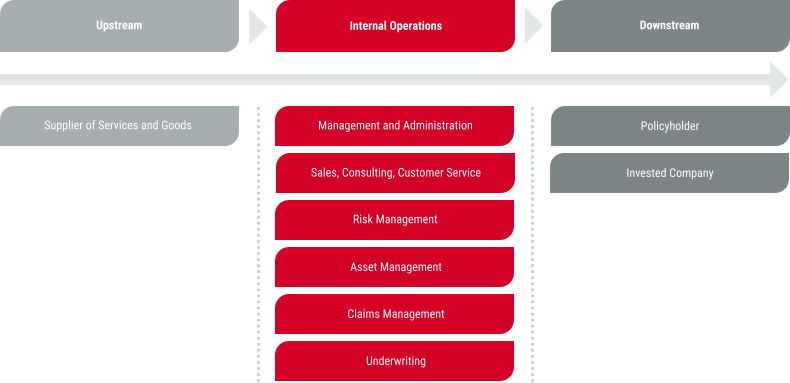
In the upstream value chain, which includes both service providers and suppliers of goods, the material topics under the ESRS play only a minor role and are therefore not included in the data collection. The company’s internal operations and business operations include management and administration, underwriting and risk management, claims management and settlement, as well as sales, advisory services and customer support. Insurance customers and investee companies are part of the downstream value chain.
Disclosure Requirement SBM-2 – Interests and views of stakeholders
Engaging with stakeholders – ranging from policyholders, sales and business partners, the professional public, (potential) employees and shareholders/investors to NGOs, society at large, the media and public authorities – is an important part of the company’s approach to corporate responsibility and takes place through a variety of dialogue formats. By incorporating stakeholder views, VIG Holding ensures that its sustainability efforts stay relevant and effective.
Key stakeholders |
Dialogue format |
Purpose/topics |
Result |
Information for the Managing Board |
|---|---|---|---|---|
Policyholders |
Contact by personal advisors, service offices or by video, telephone and email |
Involving policyholders makes it possible to identify requirements with regard to challenges and needs in good time and to adapt services where necessary. |
As part of a continuous improvement process, we constantly evaluate how customer needs can be met through our product and service offerings. |
Regular dialogue |
Professional public |
Membership in insurance associations and sustainability initiatives; |
Involving the professional public enables technical challenges, trends and needs to be identified at an early stage and key topics to be developed further in collaboration. |
The main result is the creation of a common understanding of industry-specific standards, such as the PCAF standard for calculating financed and insurance-associated emissions, and the consideration of global sustainability initiatives in the VIG business model (e.g. the ten principles of the UN Global Compact). |
Ad hoc |
Sales and business partners |
Personal contact; |
The aim of being in continuous dialogue with sales and business partners is to resolve issues related to their activities in a timely manner and to create a common understanding of current challenges. |
This ongoing dialogue is intended to ensure that enquiries and complaints received through the appropriate channels are dealt with promptly and that concepts such as tailored, industry-specific safety plans (e.g. with regard to natural hazards) are offered. |
Ad hoc |
Investee companies and potentially investable companies |
ESG investment strategy (responsible investment) |
For example, the aim of the dialogue with investee companies and potentially investable companies is to address ESG issues in a targeted manner, identify potential areas for improvement and increase ESG data transparency. |
Investors are particularly concerned with financial performance, risk management and the incorporation of environmental, social and governance criteria into business practices. The dialogue has driven products such as, investment in green bonds and the integration of sustainability criteria into investment processes. |
Ad hoc |
(Potential) employees |
(Virtual) events; |
Feedback regarding working conditions, safety and well-being is taken into account in the decision-making process. These exchanges make it possible to stay up to date on emerging challenges and existing practices, and thus develop programmes and policies that promote diversity, equality and inclusion within the workforce. |
Flexibility in how actions are implemented locally gives rise to a broad spectrum of actions and solutions. They range from diversity training to programmes to strengthen learning across generations and nationalities. |
Regular dialogue |
Shareholders/ (potential) investors |
Continuous capital market information; |
Through continuous dialogue and investor engagement, VIG provides a clear picture of its corporate strategy and ongoing business development while communicating external trends and the needs and requirements of the capital market internally. |
VIG’s actions to involve its stakeholders create greater transparency both in external reporting, through a clear understanding of strategy and business development, and internally, with regard to the expectations of capital market participants. |
Regular dialogue |
NGOs (non-governmental organisations) |
Ongoing personal or virtual dialogue with environmental protection organisations |
VIG is holding talks with relevant NGOs to exchange information on environmental and climate issues. |
Involving stakeholders makes it possible to share knowledge and create a common understanding, including with regard to VIG’s climate targets and actions. |
Regular dialogue |
Society, media, authorities |
Press conferences and interviews; |
VIG maintains an ongoing proactive dialogue with society, the press and the authorities in order to communicate current strategy and/or sustainability issues at VIG in a timely manner and to develop an understanding of society’s expectations. |
Regular press relations work creates greater transparency and understanding for the positive positioning of VIG. This is also supported by the promotion of selected cultural and social projects. |
Regular dialogue |
Depending on the topic and the stakeholder group, VIG offers various channels of communication so that issues can be raised. In addition, VIG insurance companies have considerable decision-making latitude at the local level to respond as effectively as possible to the needs of local stakeholders. Sustainability matters within VIG Holding: Group Sustainability Office (GSO), email: GroupSustainabilityOffice@vig.com
The findings from this dialogue are incorporated into various actions. In addition to the measures outlined above, they also relate to the further development of IT security and data protection. Furthermore, the multi-channel distribution approach, which includes direct sales, brokers, agents, bancassurance partnerships and digital platforms, has been further optimised to ensure comprehensive customer care and accessibility. Further information can be found in chapter ESRS 2 SBM-1 “Strategy, business model and value chain”.
In the future, VIG will continue to focus on digital innovations as part of its sustainability efforts. The aim is to increase the use of digital platforms in order to improve interaction with customers and increase its market reach. This includes the development of new digital tools and services that offer policyholders added value. Further process simplifications and automations are planned to boost productivity and efficiency, and thus enhance customer service. To support its sustainability objectives, since 2023 VIG has used the engagement provider ISS ESG as part of its engagement approach to encourage investee companies and potential investee companies to commit to achieving net-zero greenhouse gas emissions by 2050, to set medium-term reduction targets (2025–2030), and to develop decarbonisation strategies in line with the Paris Climate Agreement. Further steps planned include promoting risk literacy in VIG’s markets and, where appropriate, expanding VIG’s sustainability programme to reflect current trends and developments.
VIG Holding ensures that the Managing Board and Supervisory Board are well informed about stakeholders’ views regarding sustainability-related impacts by taking a structured and comprehensive approach, which is described under ESRS 2 GOV-2 “Information provided to and sustainability matters addressed by the undertaking’s administrative, management and supervisory bodies”.
Disclosure Requirement SBM-3 – Material impacts, risks and opportunities and their interaction with strategy and business model
The following table provides an overview of the material impacts, risks and opportunities of VIG.
Material impacts, opportunities and risks
Sub-topic |
Description |
Assessment |
Time horizon* |
Value chain |
Report scope |
||
|---|---|---|---|---|---|---|---|
Climate change mitigation |
Contribution to global warming through greenhouse gas emissions and non-renewable energy consumption associated with VIG’s insurance and reinsurance products, investments in high-emission sectors and internal operations |
Actual negative impact |
S/M/L |
Internal operations Underwriting: Corporate/Retail |
Fully consolidated companies, including at equity companies in ESRS E1-6 “Gross Scopes 1, 2, 3 and Total GHG emissions” |
||
Climate change adaptation |
Higher frequency and severity of claims due to extreme weather events and natural disasters as well as lacking awareness, risk-management insights and/or measures to reduce impacts of insured events by customers |
Risk |
S/M/L |
Underwriting: Corporate/Retail |
Fully consolidated insurance companies |
||
Climate change adaptation and mitigation |
Loss of value in capital investments (stranded assets/transition risk) and risk of negative impact on the creditworthiness due to increase in extreme weather events/natural disasters (physical risk) |
Risk |
S/M/L |
Asset Management |
Fully consolidated companies |
||
Climate change mitigation |
Investing in and/or underwriting companies that do not adequately address their impact on climate change can lead to negative media coverage and reputational damage resulting in financial loss |
Risk |
S/M/L |
Underwriting: Corporate; |
Fully consolidated companies |
||
Climate change mitigation |
Investment opportunities in green/sustainable bonds |
Opportunities |
L |
Asset Management |
Fully consolidated companies |
||
Climate change adaptation, climate change mitigation and energy |
Potential expansion of offerings and market reach due to a higher interest in insurance products covering extreme climate events |
Opportunities |
S/M/L |
Underwriting: Corporate/Retail |
Fully consolidated insurance companies |
||
|
|||||||
Sub-topic |
Description |
Assessment |
Time horizon* |
Value chain |
Report scope |
||
|---|---|---|---|---|---|---|---|
Working conditions |
Fair treatment of VIG employees through opportunities for social dialogue, freedom of association and involvement in decisions by employee representatives. |
Actual positive impact |
S/M/L |
Internal operations |
Fully consolidated companies |
||
Equal treatment and opportunities for all |
Positive impact on employees’ qualifications and career opportunities through training and development. |
Actual positive impact |
S/M/L |
Internal Operations |
Fully consolidated companies |
||
Working conditions and equal treatment and opportunities for all |
Appropriate and reliable remuneration for VIG employees secures a stable and dependable income for individuals. |
Actual positive impact |
S/M/L |
Internal Operations |
Fully consolidated companies |
||
Working conditions and equal treatment and opportunities for all |
Offering attractive working conditions beyond the legal standard leads to increased satisfaction of VIG employees. |
Actual positive impact |
S/M/L |
Internal Operations |
Fully consolidated companies |
||
Company-specific disclosure |
The use of advanced technological applications and Artificial Intelligence (AI) contributes to the development of new solutions, the automation of repetitive tasks and the optimization of resource Management. |
Actual positive impact |
S/M/L |
Internal Operations |
Fully consolidated companies |
||
|
|||||||
Sub-topic |
Description |
Assessment |
Time horizon* |
Value chain |
Report scope |
||
|---|---|---|---|---|---|---|---|
Information-related impacts for consumers and/or end-users |
Potentially insufficient or misleading information from VIG to their customers could lead to a negative impact for policyholders. |
Potential negative impact |
S/M/L |
Underwriting: Retail |
Fully consolidated insurance companies |
||
Information-related impacts for consumers and/or end-users |
Potentially insufficient or misleading information from VIG to customers could lead reputational damage and the loss of business relationships. |
Risk |
S/M/L |
Underwriting: Retail |
Fully consolidated insurance companies |
||
Personal safety of consumers and/or end-users |
Loss of customer data can lead to negative impacts for customers. |
Potential negative impact |
S/M/L |
Underwriting: Retail |
Fully consolidated insurance companies |
||
Social inclusion of consumers and/or end-users |
Closing the protection gap by improving access to insurance products that improve personal resilience. |
Actual positive impact/opportunity |
S/M/L |
Underwriting: Retail |
Fully consolidated insurance companies |
||
Company-specific disclosure |
Promoting Risk Literacy to enable as many consumers and end-users as possible, whether customers of the group or not, to make informed and considerate decisions in relation to the risks they may face. |
Actual positive impact |
S/M/L |
Underwriting: Retail |
Fully consolidated insurance companies |
||
|
|||||||
Sub-topic |
Description |
Assessment |
Time horizon* |
Value chain |
Report scope |
||
|---|---|---|---|---|---|---|---|
Corporate culture |
Financial loss due to inadequate IT security measures. |
Risk |
S/M/L |
Internal Operations |
Fully consolidated companies |
||
Corporate culture |
Reputational damage leading to financial loss resulting from conducting business with companies that have inadequate business practices. |
Risk |
S/M/L |
Underwriting: Corporate |
Fully consolidated companies |
||
Corporate culture, protection of whistleblowers, and corruption and bribery |
Financial loss resulting from non-compliance with regulatory requirements. |
Risk |
S/M/L |
Internal operations Underwriting: Retail |
Fully consolidated companies |
||
Political influence and lobbying activities |
Contributing to the political and regulatory agenda through political engagement, mainly through memberships. |
Actual positive impact |
S/M/L |
Internal Operations |
Fully consolidated companies |
||
Company-specific disclosure |
Environmental, social, cultural and other commitments reflect the company’s stakeholder engagement. |
Actual positive impact |
S/M/L |
Internal Operations |
Fully consolidated companies |
||
|
|||||||
Compared with the 2024 reporting period, the material impacts, risks and opportunities were consolidated in 2025. In addition, two additional company-specific impacts have been identified, which are now also taken into account. VIG reports on the requirements set out in the ESRS under ESRS E1 “Climate change”, ESRS S1 “Own workforce”, ESRS S4 “Consumers and end-users” and ESRS S4 “Consumers and end-users”, ESRS G1 “Business conduct”. In addition, company-specific disclosures are described in chapters ESRS S1 “Own workforce”, ESRS S4 “Consumers and end-users” and ESRS G1 “Business conduct”.
VIG’s business activities have both positive and negative impacts on people and the environment. For many years, the material impacts, risks and opportunities of VIG have influenced the business model, the value chain, the strategy and the decision-making processes. Particular emphasis should be placed on VIG’s sustainability programme, through which sustainability aspects have been gradually integrated into the core business strategy.
Consumer-related aspects include, among other things, information-related impacts that may arise if insufficient or misleading information leads customers to make incorrect decisions. To minimise these risks, VIG ensures clear, transparent and understandable communication with customers. In addition, VIG contributes to social inclusion by expanding access to insurance products that strengthen the personal resilience of consumers and end-users. In this way, VIG contributes to reducing the insurance gap and strengthening the financial security of broad segments of the population. Another key focus is on promoting risk literacy. VIG supports customers through information campaigns, advisory services and educational initiatives that help them better understand risks and make informed decisions.
Risks relating to customers’ personal safety are also taken into account, for example through prevention programmes designed to help avoid loss events and through the provision of safety-related information. Potential negative impacts, such as the loss of customer data, are addressed through appropriate control mechanisms.
VIG has an exclusively positive impact in terms of improving employee well-being, promoting diversity and creating a more inclusive work environment. Different experiences and backgrounds are valued and contribute to creativity, motivation and innovation.
VIG contributes to the shaping of the political and regulatory agenda through political influence and lobbying activities, in particular through memberships in professional and industry associations. In addition, VIG promotes the social commitment of its employees and thus strengthens their social impact.
Further details on the impacts, risks and opportunities and the corresponding management approaches are described in the topic-specific chapters.
There are risks and opportunities for VIG in its internal operations and in underwriting and asset management. Operational risks include insufficient ESG disclosures, a lack of sustainability data for reporting purposes, and possible IT security breaches that could result in data losses and harm to VIG’s reputation. Identifiable climate risks are included in the best estimate of technical provisions by way of rate-setting and reserve allocations. In forecasts, these identifiable climate risks are implicitly taken into account in the expected value of cash flows and in the solvency capital requirement applied for the impairment test (see under “Additional disclosures” in Note “25.5. Goodwill” in the notes to the consolidated financial statements).
Asset management may involve companies that do not actively monitor their environmental impacts. This can lead to market and reputation risks. These risks may lead to a reduction in the fair values of assets and consequently, where applicable, to impairment losses to be recognised in the separate and consolidated financial statements. The valuation process for determining the fair value of financial assets is described under “Additional disclosures” in chapter 25.9 “Calculation of fair value” in the notes to the consolidated financial statements.
Non-sustainable investments may be subject to impairments due to changes in market requirements or regulatory requirements. Accordingly, the medium- and long-term focus will be on further integrating the sustainability activities of investee companies into investment decisions. Climate-related risks, such as increasing insurance claims from extreme weather events, will lead to adjustments in underwriting practices and reserve allocations in connection with changed claims experience. These risks are actively monitored by the actuarial function in order to ensure consistency with sustainability risks and financial resilience.
VIG addresses the above-mentioned impacts, risks and opportunities through a broadly diversified business model geared towards long-term stability and sustainable growth.
As part of the company’s own risk and solvency assessment, the overall regulatory solvency requirement is projected together with the solvency capital requirements and the available capital base over the entire planning period. The extent to which possible deviations from the planned business development affect VIG is determined on the basis of appropriate stress tests or scenario analyses. This is to ensure that even in the event of adverse business developments VIG will have access to sufficient capital to cover its own liabilities and that regulatory solvency capital requirements can be met at all times.
The knowledge gained from the projections and regulatory stress tests, together with other internal analysis results, form the basis for the definition of strategic actions. In the course of reporting to the VIG Holding Managing Board, the preliminary results are discussed and the business planning of VIG is adjusted if necessary. The Managing Board reviews the strategic direction of VIG based on the results. It includes the business strategy, which defines the main approaches to achieve the targets, a risk strategy, which determines the appropriate risk management actions for material risks, and the capital strategy, which ensures sufficient own funds with a view to the defined risk-bearing capacity.
VIG has pursued a conservative reinsurance approach for many years and sees risk transfer through reinsurance in the non-life area, particularly in the area of natural disasters, as a key risk mitigation technique to protect against major and catastrophic events and any balance sheet volatilities. The reinsurance strategy is characterised by a conservative retention policy as well as the targeted selection and accompanying monitoring of reinsurers. VIG insurance companies must follow a Security List defined by the Reinsurance Security Committee. Reinsurers that are not on this list require individual approval by the Reinsurance Security Committee. Concentration risk in the area of reinsurance is also mitigated by means of diversification.